


Every day, hundreds of millions of people around the world listen to podcasts - in any app they want. But the key word here is listen - open podcasting only really works with audio. The moment you want video, you’re limited to one or two platforms that tightly control the experience and drown it in ads.
The good news? Podcasters can now deliver both audio and video in any supporting app, letting listeners switch formats seamlessly wherever they listen.
See it in action here: https://fountain.fm/episode/bb3MURtHHVbPFkvvDpTc
And read on to learn how it works under the hood.

Why Video Can’t Be Ignored
Over the last 20 years, the internet has become more social and far more crowded with content. While this gives listeners more choice, it also means creators face tougher competition.
Video has become one of the most reliable ways to stand out. Although audio listeners tend to be more loyal, audio content is harder to discover. Short video clips can break through on social platforms and reach people who may never find the podcast otherwise. And when that video isn’t locked to a single platform like YouTube, the whole podcasting experience becomes better for both creators and listeners.
The Status Quo
Podcasts are usually distributed via RSS feeds - computer-readable documents that contain information about the podcast: its title, description, and more. ‘Enclosures’ are elements in the RSS feed that link to the audio file for each episode, which lets podcast apps download the audio to the listener’s device.
Podcasts in video form do exist, so how is that implemented today, and what are the drawbacks?
Alongside their RSS feeds, creators often upload video versions of their podcast to YouTube and other closed platforms. This makes video a great way to consume a podcast for users of those platforms, but it moves us away from open podcasting because the video files aren’t publicly accessible and can’t be viewed in your app of choice.
Another option is to include video directly in the RSS enclosure: apps like Apple Podcasts support certain video formats, such as MP4, through open podcasting protocols. That’s a much better approach than relying on closed platforms, but it still comes with a few issues. Conventional video formats aren’t ideal for many scenarios - file sizes are large, resolutions are fixed, and streaming is less flexible. And even if you solve those problems, most podcast apps were built for audio, so putting video where they expect audio can break things. Some podcasters work around this by publishing separate audio and video feeds, but that only complicates things unnecessarily, especially when modern standards provide a cleaner solution.
Alternate Enclosure: Podcasting 2.0 Solution for Video
Podcasting 2.0 is a set of community-driven standards that improve the experience for both podcasters and listeners. One such improvement is the alternate enclosure - a way to include multiple versions of your episode media in the RSS feed.
With this approach, a hosting company can include the regular audio in the main enclosure and add a video file as an alternate enclosure. This allows audio-only apps to keep working as they always have, while apps that support video can offer a full video experience. Video-supporting apps can choose to show both options or simply default to video.
Video is more demanding than audio, but modern formats make it far more practical. Formats like HLS support multiple resolutions and split videos into many smaller segments, making distribution and playback much more efficient. This leads to a smoother experience for listeners and lower costs for podcasters.

Video at Fountain
Fountain aims to make video podcasting open, giving podcasters and listeners real choice instead of locking them to a single platform.
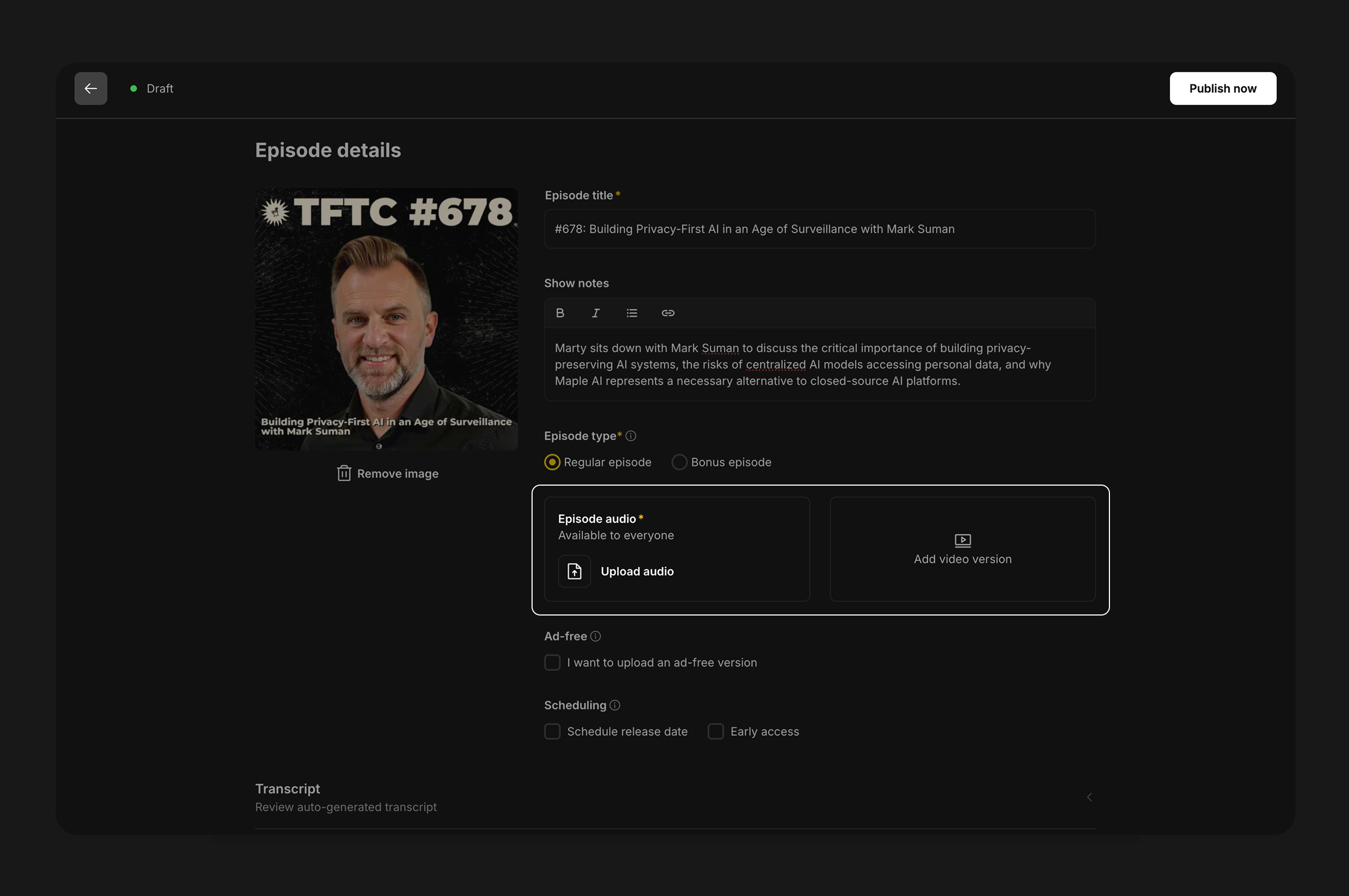
Fountain for Podcasters, our hosting platform, lets creators upload video alongside audio. We optimize each video for both standard and high quality playback, so it works well even on limited connections. We then include both audio and video in the RSS feed, and any app that supports video can display it.
Fountain App, our podcast player, lets anyone watch videos included in a podcast’s RSS feed - even if the video isn’t hosted on Fountain. Listeners can switch between audio and video, download videos for offline playback, and support creators while they watch.
We’ve also made major improvements to the video experience on desktop. The web version of Fountain now offers an interface that rivals video-native platforms: closed captions, advanced controls, automatic quality selection, comments, and more. You can check it out here.
We hope this shows podcasters and listeners what’s possible with open standards that don’t lock video to individual platforms or proprietary protocols. As more hosting companies and apps adopt these standards, the whole ecosystem becomes more open, putting pressure on closed platforms to offer a better, more seamless experience.
How to Support Open Video Podcasting
Hosting companies: Support alternate enclosures and allow creators to upload both audio and video.
Podcast apps: Support alternate enclosures and let users watch video directly in the app.
Podcasters: Ask your hosting provider to support alternate enclosures or switch to one that already does, like Fountain for Podcasters
Listeners: Tell your podcast app you want open video support or switch to an app that already has video, like Fountain. Most importantly, let your favorite podcasters know why open video podcasting matters!
Finally checking this out now - love your implementation! Curious: what resolution/encoding are you using? 720p? 1080p?
Awesome!